
Democratic Socialism Will Soon Replace Capitalism

Theory and logic indicate Socialism’s superiority. If centralized planners, in the technological age of data mining and artificial intelligence, responsibly control the processes, allocate resources, create an agreeable work ethic, and capably enter into the international trading system, a form of Socialism can succeed. Apparently, except for China, whose economic system has Socialist characteristics that combine grassroots policies with authoritarian decisions, and mixes government and private enterprises in a regulated environment and managed economy, the public views Socialism as a failed concept. Capitalism is preferred and has a stalking horse, Democratic Socialism, which replaces Capitalism’s trickle down prosperity with a firm and equitable income distribution.
Despite numerous short-term failures and theoretical inferiority, Capitalism sustains, going through crises of fall, revival, and survival. If Capitalism fails to continue to revive and survive, can Democratic Socialism replace Capitalism? Manifold government legislation and regulation have already steered the course. Before becoming totally decisive, changes in qualifying the accepted system must occur. Enhancing quality of life, increasing material wants, and augmenting Gross National Product are becoming lesser qualifications. The future portends more importance to meeting challenges posed by climate change, pandemics, greenhouse gases, and other crises. The future portends more importance to survival, to having sufficient means to meet the next day in a gracious and inviting manner.
In a capitalist system, the capitalist owns means of production, invests profits to regenerate more profits, and increases capital from constant reinvestment. An outgrowth of the industrial revolution, Capitalist economies promoted industrial progress and substantially increased the material wants of much of the worlds’ population. Stumbling through recessions, depressions, and panics, Capitalism periodically breaks down, retreats, and petitions government rescue. From another perspective, pure Capitalism has a short life, and needs to be constantly resuscitated. In one resurrection. Capitalism embraced neoliberalism, a global free-enterprise sub-system with a mixed economy that uses capitalist structures. Forecasted global problems indicate that neoliberaism cannot meet future challenges; a new socioeconomic system is warranted.
Pure Socialism is a centralized economic and political system, where the government owns a major portion of industrial production and regulates production and prices. In its purity, Socialism has two primary built-in impediments ─ difficulty to efficiently allocate resources and struggles to sufficiently motivate workers. The former occurs from companies hoarding to meet quotas and creating waste, and from producers unable to meet commitments and creating production bottlenecks. Failure to sufficiently motivate labor is a product of workers’ lifetime employment arrangement, which lessens incentive to operate in the most efficient manner. Although a similar problem occurs in the capitalist system, Socialism needs special safeguards to prevent a sinecure system, where close associates are favored by top management.
Democratic socialism has many definitions. For this conversation, Democratic Socialism defines an economy and society that is politically democratic, allows private enterprise to generate surpluses, and uses government controls to assure profits are optimally reassigned for both business (profit reinvestment) and public needs (taxation). Government policies, such as subsidizing, regulating, and distributing, help shape the economy. Social ownership of businesses is encouraged. These include worker-owned cooperatives, publicly owned enterprises managed by workers, and workplace democracy, where workers’ representatives have a seat on corporation boards. Some inefficient and vital industries necessitate a form of state ownership, but most industries are best run as private enterprises.
Democratic Socialists consider central planning for major public industries — mass transit, housing, and energy — and permit market mechanisms to determine the demand for consumer goods. Democratic Socialism attempts to combine the positives of Capitalism and Socialism and eschew the faults of other systems.
Behind the appearance of Capitalism’s (free enterprise) success in providing material wants to vast population, lays failures — economic depressions, world wars, civil strife, and inability of the private sector to respond quickly to catastrophes, as was shown by responses to the corona virus.
Since its beginnings, periodic economic recessions, depressions, and panics gripped the United States . Government actions to repair the defects and adjust for the failures proceeded from recognition that Capitalism became comatose every few years and urged remedies to be constantly revived. A plethora of laws, regulations, agencies, government deficits, and other amelioration have provided stitches, transplants, band-aids, and surgical operations to patch up and rescue a constantly ailing patient, reviving the collapse after each fall. The history of Capitalism reveals a system that ignored the nation and a nation that did its utmost to maintain free enterprise.
From 1867 to 1929, the U.S. economy exhibited a shock every several years. Seven severe depressions or financial panics occurred during that 62-year period. One of these started in 1873, and is considered to be the Long Depression ─ a period of bursts of prosperity and contractions from 1873-1896.
Constant economic disturbances and sputtered growth prompted lawmakers to socialize capitalism, and correct the excesses of “rugged individualism” capitalism, in which a few financiers exercised control of the economic system and used it for their private gain ─ essentially robbing banks by owning them. Establishment of the Interstate Commercial Commission in 1887 for regulating the railroads, passage of the Sherman Antitrust Act of 1890, which “declared illegal all combinations in restraint of trade,” creation of the Federal Reserve System in 1912 to regulate the money supply, stabilize the financial system and subdue inflation, passage of the Clayton Act in 1914 in order to further restrict anti-competitive practices and enforce the earlier Sherman Antitrust act, establishment of the Federal Trade Commission in 1914, an agency with powers to “prevent business practices that are anti-competitive or deceptive or unfair to consumers,” and formation of The Federal Communications Commission , by the Communications Act of 1934, to “maintain jurisdiction over the areas of broadband access, fair competition, radio frequency use, media responsibility, public safety, and homeland security,” are a few examples of government attempts to rectify Capitalism’s problems. They did not halt the calamities ─ “boom” and bust” persisted; speculation remained rampant; mergers tending to monopolies continued; banks went bankrupt.
The call for regulatory legislation proved that the capitalist system, which had its moments of genuine success, was, as constituted, only partially effective and efficient ─ it could not exist without government intervention. Legislators, in their ardor to preserve the system, neglected to realize that the capitalist system had survived with special advantages. How far would the capitalist system in the United States have advanced without a century of slave labor, land and resource appropriation from the Native Americans, constant wars to seize territory in North America and command global markets, and tens of millions of immigrants working at subsistence wages? Government attempts to stabilize the erratic free enterprise system with regulatory capitalism served as a temporary palliative, which eventually became co-opted and could not prevent the Great Depression.
Hunger and unemployment in the land of plenty drove the New Deal toward the rescue plan of welfare capitalism ─ government sponsored programs and legislation that fostered institutions to re-distribute wealth and enable all citizens to escape poverty and gain equal opportunity. Soon more rescue came from government construction of transportation, communication, and power infrastructure ─ interstate highways, airports, hydroelectric and nuclear power plants, and ARPANET (the first wide-area packet switching network). Equal opportunity laws, subsidized mortgage loans, and direct coordination in research and development between the defense department and private industry drove free enterprise toward a mixed economy. Government defense contracts developed the electronics and aviation industries; Eisenhower administration’s interstate road system magnified the automobile and steel industries.
The role of the defense department in providing sustenance to the free enterprise system is insufficiently considered. Entire industries — defense, armaments, electronics, shipbuilding, aviation, space exploration — and parts of some industries — airlines, plastics, chemical, metallurgical, Internet — owe their existence and prosperity to defense department developments, funds and contracts. Airplane designs and manufacture are direct outgrowths from defense industry aircraft. Airline growth relied upon government subsidies, mail and freight deliveries, and airport constructions.
OPEC’s higher oil prices during the 1970s challenged a troubled Capitalism, initiating inflation, ultra-high interest rates, and a 1981 recession, which invoked the principally recognized rescue plan ─ pump the economy with government deficits and easy credit ─ the most accepted means to maintain the system.
Since the Reagan administration, the Gross Domestic Product (GDP) has closely followed an almost continually increasing sum of public and private debt. Growth in the Capitalism system became allied to and dependent upon the ever growing debt.
GDP and DEBT
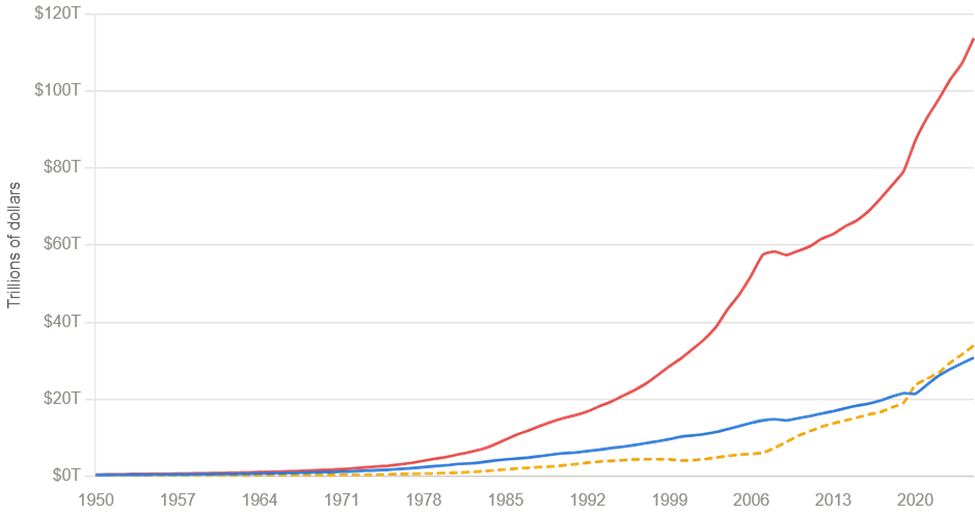
Red is Total Credit Outstanding
Blue is GDP
Dashed yellow is government debt
Note the slow growth of GDP until debt started to escalate, government debt quickening during the Reagan administration, and its decisive role in replacing stalled overall debt by reinvigorating the GDP after the 2008-2009 financial crisis.
Excessive debt enabled the Reagan administration to emerge from its incipient recession. Escalated private debt offset budget surpluses during the Clinton administration. A combined whammy of private and public debt during the Bush term soon hit a wall and caused the huge 2008 recession. Wisely, Obama pursued slow growth policies that, by using a slow accumulation of debt, prevented any downfall during his two administrations.
Almost all money is conventional debt, issued by banks in their lending process, and by Federal Reserve open market operations. Capitalism runs on this debt. As debt plus interest is retired, new and more expensive debt must replace it or the monetary base will decrease and money available for purchase of goods and services will decline.
GDP and the MONEY SUPPLY
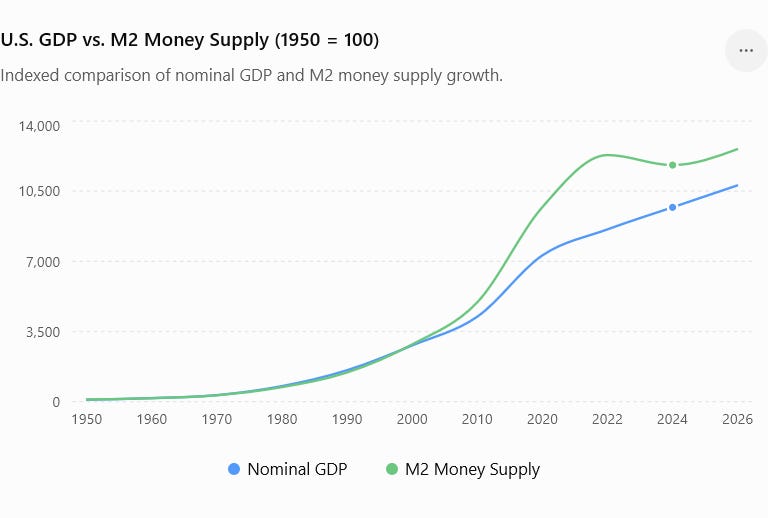
Here we observe the exact relation between the GDP and money supply and their divergence after the Federal Reserve over pumped the economy in order to prevent additional disasters occurring from the 2008-2009 financial crisis. Where did the excess money supply find a home; search for excessive investment in the stock market and investigate purchasing power losses to inflation.
Capitalism needs profit in order to grow and generate its periods of prosperity. Because profit is the lifeblood of the capitalist system, understanding the modern concept of profit ─ how profit is made, its functions, problems, benefits, and failures ─ provides an improved understanding of the contemporary Capitalism system.
The price of goods Pr = C+ P, where C is cost, and P is profit. In the production process, excepting for some subsidies, no funds are supplied to the economy for purchase of the goods represented by profit, or as Karl Marx defined it, the surplus value, the value in goods that workers’ wages are insufficient to purchase. From where comes the added purchasing power to obtain the mysterious profit?
Increasing the Purchasing Power
(1) Private debt supplies a major increase in purchasing power.
(2) Distribution of profits by dividends, share buybacks, and bonuses to management and employees recirculate profits for purchase of goods.
(3) Government debt supplies the knockout punch to clear the shelves, growing when private debt shrinks.
(4) A positive trade balance brings purchasing power into the system, reclaiming dollars circulating throughout the world. A negative balance, which has occurred during the last decades, removes purchasing power from the system.
(5) Some liquid funds from savings and investments re-enter the system.
The first three components have operated strongly and actively to restore purchasing power. Government debt, issuance of bonds to foreign buyers reclaim the dollars lost to a negative trade balance.
Ultimate failure
The ultimate failure of the profit system is apparent. To continually increase purchasing of goods and obtain more profit, the money supply must increase. Trade imbalances (subsidized by government debt), and retirement of private debt soon hit a wall and a decrease in the money supply occurs. An estimated $40 trillion of it may be double bookkeeping, nevertheless, how much further can the present $110 trillion total debt advance? When, debt servicing becomes saturated, which means the money supply cannot increase, wants from all sectors are fulfilled, or insufficient workers are available for increased production (due to low birth rate and immigration restrictions), the economy will stagnate and soon decline. Proper actions can slow the failures but not forever. Bust is inevitable.
The true meaning of profit
Profit is perceived with awe, glorified as the deserved result of risky and arduous effort. Household debt is viewed with sympathy, as an opportunity to purchase hard goods and participate in the material life of the nation for those who cannot immediately earn enough to buy the goods. Government debt has severe detractors; many consider it a theft on future generations. The true meaning of profit is that they are all the same, the principal component of someone’s profit is debt accrued by others. When debt stagnates, and it eventually must, the economy will stagnate and profits will stagnate. The latter conditions lead to decreased employment, decreased investment, and decreased purchasing power. These provoke inabilities to repay debt, bankruptcies, and tighter lending requirements. The money supply shrinks and the GDP shrinks. Government valiantly attempts to rescue the falling economy and the efforts provide plants more bricks in the Democratic Socialist structure.
A Capitalist system does not exist on its own merits; capital formations are only one part of a complex socioeconomic system, which includes credit control, welfare, government spending, taxes, subsidies, regulation, directives, and oversight, all which determine production, growth, and progress. The entrepreneur deserves remuneration, but. in a final analytics, he/she and the capitalist system maintain existence due to government spending.
Profit is not tied to Capitalism, and other economic systems can incorporate it for growth and material enrichment. A severely modified Capitalism can more efficiently and effectively employ profit, which has significant benefits. Enter the Democratic Socialist system, issuing credit to those willing to amortize expensive items that would ordinarily require years of savings. Dividends to stockholders and harbored profits from the credit purchases are recirculated as bonuses to laborers. The profit motive remains, and the rewards enrich a greater number of people.
Industry wide sharing of profits between investors and employees extends the years between economic cycles and allows stable and high profits ─ previous year distributed profit allows purchase of next year’s surplus. Less domestic and government credit are needed to keep the system alive.
The Economic Consequences of Wealth Concentration
An economy that has operated as “trickle down” has reached a peak, and it is time for an economy that pours itself out for all. Share the wealth and lessening inequality by distribution of income are not just idealistic expressions or populist proposals; they are sound economics. More equitably distributed wages and spending power lessen social grievances, reduce social problems, and increase domestic spending. More equal distribution of wealth has also been associated with improvements in national health. Fairness to all reflects as benefits to all, including a lower need for government spending on social programs.
Rationalizing ill-conceived wealth distributions by describing the American poor as wealthier than the lower middle class in many developed nations is a deception. Poverty is defined as an absolute number, but its effects are relative. The lower wage earners in the United States are unaware of what they have in relation to foreigners; they are aware of what they do not have in relation to those living close to them. The wide disparity in wealth creates resentment and tension, and leads to psychological and emotional difficulties. Minimizing social problems combiner the giving of more to the lower classes with the taking of less by the upper classes.
The social problems and associated costs in developed nations that have wide distributions of income and wealth are well-documented — elevated mental illness, crime, infant mortality, and health problems. Every citizen suffers from and pays for the social problems derived from income inequality, an unfair condition in a democratic society. Several investigators have clarified the social determinants of health.
Kawachi, I. and B.P. Kennedy, 1997, in Socioeconomic Determinants of Health: Health and Social Cohesion: Why Care About Income Inequality? British Medical Journal.
Growing evidence suggests that the distribution of income, in addition to the absolute standard of living enjoyed by the poor, is a key determinant of population health. A large gap between rich people and poor people leads to higher mortality through the breakdown of social cohesion. The recent surge in income inequality in many countries has been accompanied by a marked increase in the residential concentration of poverty and affluence. Residential segregation diminishes the opportunities for social cohesion.
University of Chicago, Nov, 16-22, Sir Michael Marmot, The Social Determinants of Health and Disease Health
One of the dominant features affecting the health situation of all industrialized countries is the social gradient in health and disease. Analysts who approach this topic commonly think of it as a problem of poor health for the disadvantaged and good health for those who are not in the disadvantaged category. This is an inadequate way to pose the problem. The Whitehall Study of civil servants showed that, amongst people who are not poor, there is a social gradient in mortality that runs from the bottom to the top in each society. People in each socio-economic category have worse health than those above them in the hierarchy.
The Future
A future of growing challenges — climate change, pandemics, robotics and artificial intelligence replacing workers, greenhouse gas emissions heating the atmosphere, change from fossil fuels to renewable energy sources, prevention of nuclear war, migration chaos, political polarization, and redistribution of the wealth — demand a realignment of the socioeconomic system.
Governments are wanted that can assure the safety and security of all the worlds peoples, no matter their economic status, and no matter the hardships of the prevailing circumstances. Wealth will be less a measure, and escaping human extinction will be the motivation, requiring government action in many aspects that shape human existence. Capitalism will slowly evolve into a system that reflects the demands of a global society, a Democratic Socialist system that provides the structures for maintaining democratic substance and resolves the challenges of a difficult future.
Here is something to ponder on that relates directly to the difference between what excited people 250 years ago, what could have been, and what we have ended up with today: https://peeta462032.substack.com/p/usa-250-the-word-the-founding-fathers.
John Locke wrote that every person has a natural right to life, liberty and estate. When Jefferson drafted the Declaration, estate disappeared. In its place came the pursuit of happiness.
Thomas Paine argued that the earth, in its natural state, was the common property of the human race. Cultivation had made land productive, but it had also, necessarily, dispossessed everyone who did not hold title to it. Paine proposed a national fund, paid for by landowners as a form of ground rent on the value they had monopolised, which would pay every citizen a lump sum on reaching adulthood, and a pension in old age. Not charity. Compensation, owed as a matter of justice, for the enclosure of what had once belonged to everyone. In compensation for the loss of their 'estate'.
A lump some on reaching adulthood could allow the purchase of a house, ones estate, without which its not possible to settle down with a mate and raise children.
John Locke, Adam Smith and Thomas Paine were of like mind in this respect.
It's a bastardised form of capitalism that we have. It didn't have to be this way. But the people who determined the issue were the land and slave owning classes.